Explore our History
Cosmati Pavement
The great pavement in front of the High Altar of Westminster Abbey is a unique and remarkable object. The complexity and subtlety of the design and workmanship can be seen nowhere else on this scale.
About the Cosmati Pavement
It was laid down in 1268 by order of Henry III who had started re-building Edward the Confessor's Abbey in the new Gothic style in 1245. The workmen came from Rome, with a man called Odoricus at their head. The pavement belongs to a type of inlaid stone decoration known as Cosmati work, after one of the families of craftsmen who specialized in it and the technique is called opus sectile, 'cut work'. This differs from ancient Roman and earlier medieval mosaic work which consists of square stones of equal size. It is also abstract in design. There is an even bigger contrast with the other great 13th century pavement at the Abbey, that in the Chapter House which is a tiled floor in the English tradition.
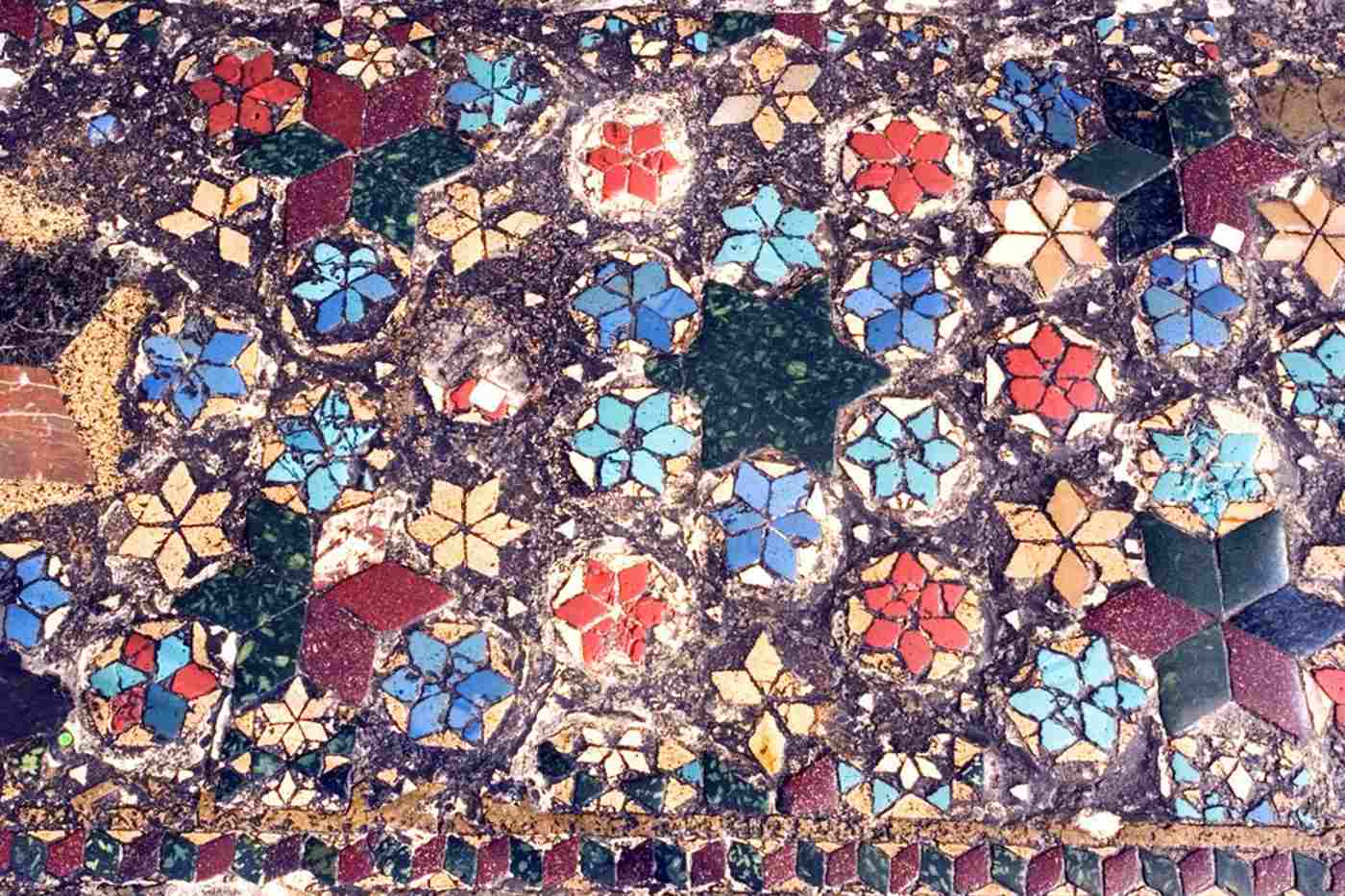
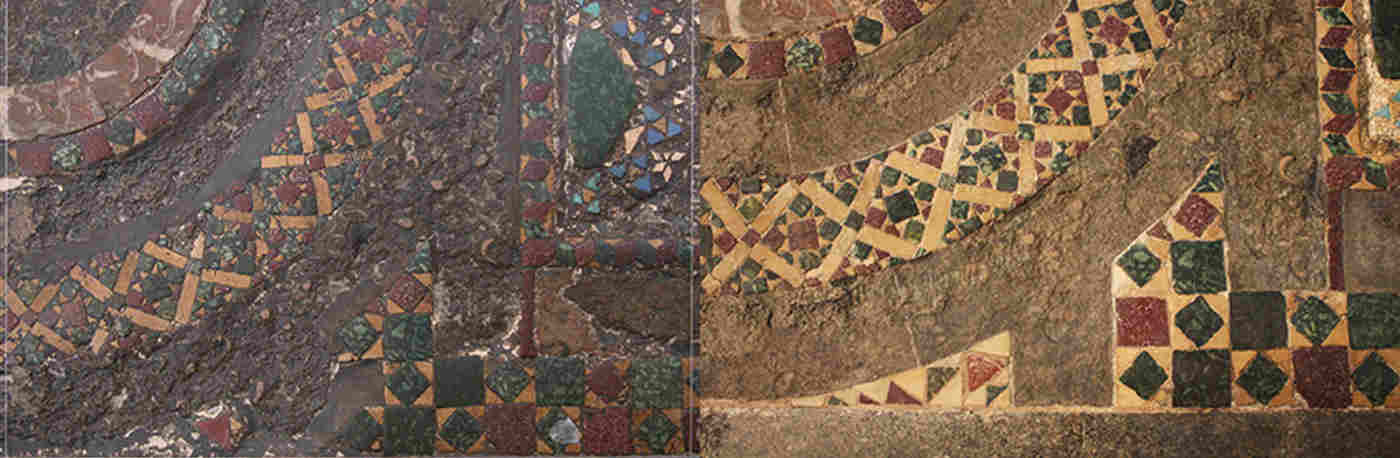
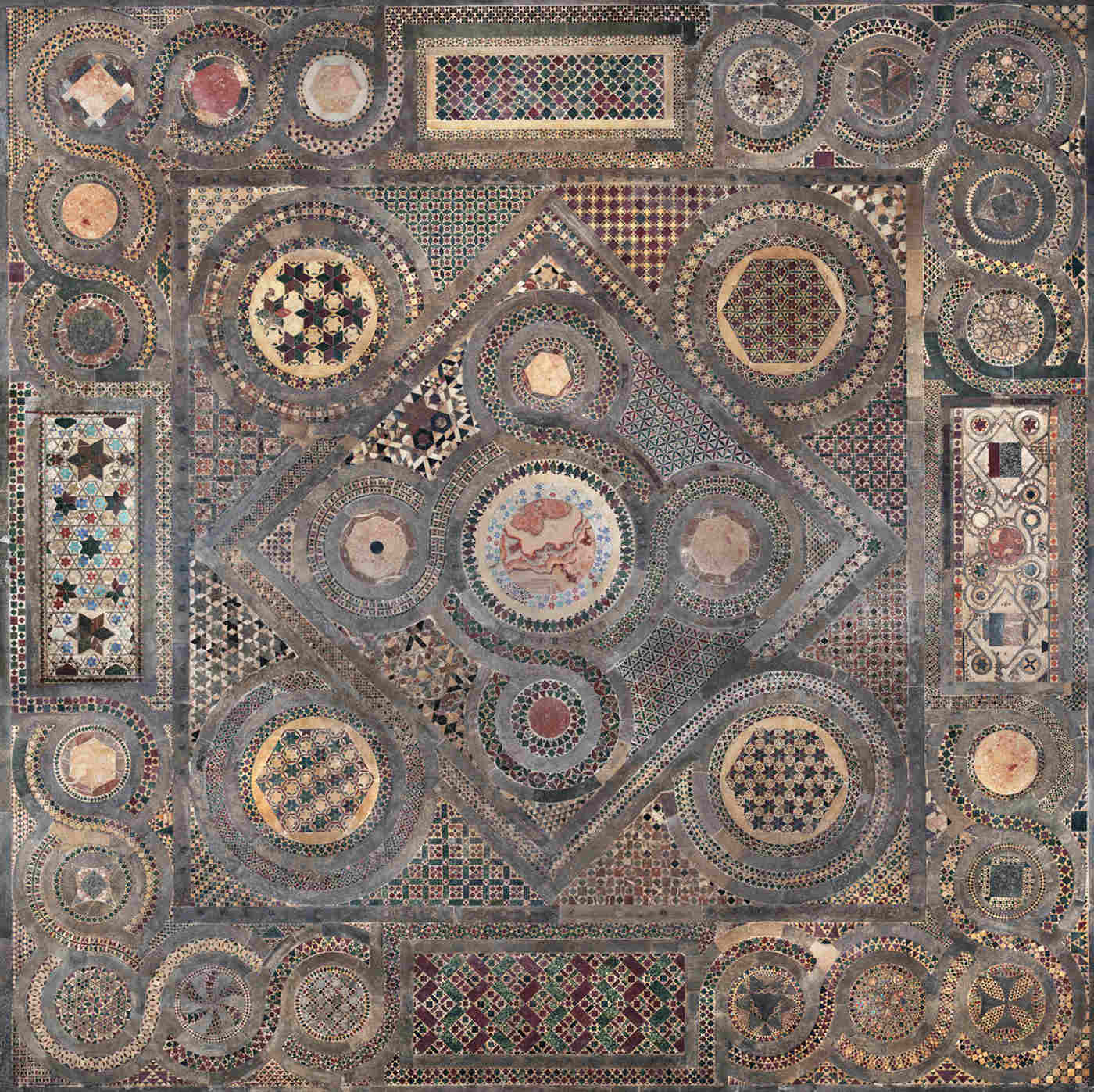
The great pavement is 24 feet 10 inches (7 metres 58 centimetres) square, with dimensions calculated in Roman feet and consists of geometrical patterns built up from pieces of stone of different colours and sizes cut into a variety of shapes: triangles, squares, circles, rectangles and many others. The central roundel is made of onyx and the pavement also includes purple porphyry, green serpentine and yellow limestone. Also part of the original material are pieces of opaque coloured glass – red, turquoise, cobalt blue and bluish white. It lies on a bed of dark limestone known as Purbeck marble. This is a major departure from Italian methods, since at home the workmen used white marble as a base. The use of glass in a pavement also goes against Italian practice.
The design consists of a broad border with a rectangle in the middle of each side and five roundels between each rectangle. The border encloses another square set transversely with its corners pointing north, south, east and west. Between the inner border and the transverse square are four triangular spaces occupied by large roundels. Within the transverse square is a pattern known as a quincunx, with a large roundel in the very centre flanked by four roundels as if in orbit around the centre. The basic layout is a four-fold symmetry, but in detail the variations are endless. No two roundels are the same. Of the four 'orbiting' roundels one is circular, one hexagonal, one heptagonal and one octagonal. The infill patterns are all different.
Inscriptions
The three damaged inscriptions, formed of brass letters, refer to the end of the world, calculating that it will last for 19,683 years (Italian Cosmati pavements do not have inscriptions). They were copied in the 15th century by the Abbey chronicler John Flete. The Latin inscriptions can be translated as:
In the year of Christ one thousand two hundred and twelve plus sixty minus four, the third King Henry, the city, Odoricus and the abbot put these porphyry stones together.
If the reader wisely considers all that is laid down, he will find here the end of the primum mobile; a hedge (lives for) three years, add dogs and horses and men, stags and ravens, eagles, enormous whales, the world: each one following triples the years of the one before.
The spherical globe here shows the archetypal macrocosm.
Why was the year 1268 expressed in such a roundabout fashion? It is usually suggested that 1212 plus 60 equals 1272, the date of Henry III's death, and 60 minus 4 equals 56, the length of his reign. It would seem therefore that the inscriptions were added shortly after his death. The abbot mentioned was Richard de Ware, who was buried beneath the pavement. Richard Sporley, a medieval monk of Westminster, wrote "The primum mobile means this world, whose age or ending the writer estimates, as he imagines it, by increasing the numbers three-fold". So a hedge lives three years, a dog nine, a horse twenty seven, a man eighty one and so on. The final date is calculated by a chronology based on the mythical life-spans of animals. And he explains that the macrocosm is "the great world in which we live", the microcosm being man. The 'spherical globe', he says, is "the round stone, having in itself the colours of the four elements, fire, air, water and earth". According to the only medieval interpretation we have, the pavement thus symbolises the world, or the universe, and its end.
The pavement was thoroughly cleaned and conservation and consolidation work was carried out and it was re-dedicated by the Dean at a service on 21st May 2010.
A postcard of the central section of the pavement is available from the Abbey Shop.
Photographs can be purchased from Westminster Abbey Library.
Further reading
"The Cosmatesque mosaics of Westminster Abbey. The pavements and royal tombs..." by Warwick Rodwell & David Neal, 2019
"Westminster Abbey. The Cosmati Pavements" edited by Lindy Grant and Richard Mortimer. Courtauld Research Papers no.3, 2002. [includes a photogrammetric survey fold out with types of materials used]
"The Cosmati pavements...addressing the archaeological issues" by Warwick Rodwell in BAA Conference Transactions 2015.
"Patterns of Thought. The hidden meaning of the great pavement of Westminster Abbey" by Richard Foster, 1991.
"The Cosmati mosaics at Westminster. Art, politics and exchanges with Rome..." by Paul Binski and Claudia Bolgia in Romisches Jahrbuch der Bibliotheca Hertziana 45, 2021/22.
"The Cosmati at Westminster and the English Court Style" by Paul Binski in The Art Bulletin, March 1990.
"King Henry III and the Cosmati work at Westminster Abbey" by David Carpenter in The Cloister and the World...1996.
© Text and photos: Dean and Chapter of Westminster.
Own a piece of the Cosmati
Jewellery and homewares inspired by the complex patterns and unique craftsmanship of the Cosmati pavement are available from the Westminster Abbey Shop.